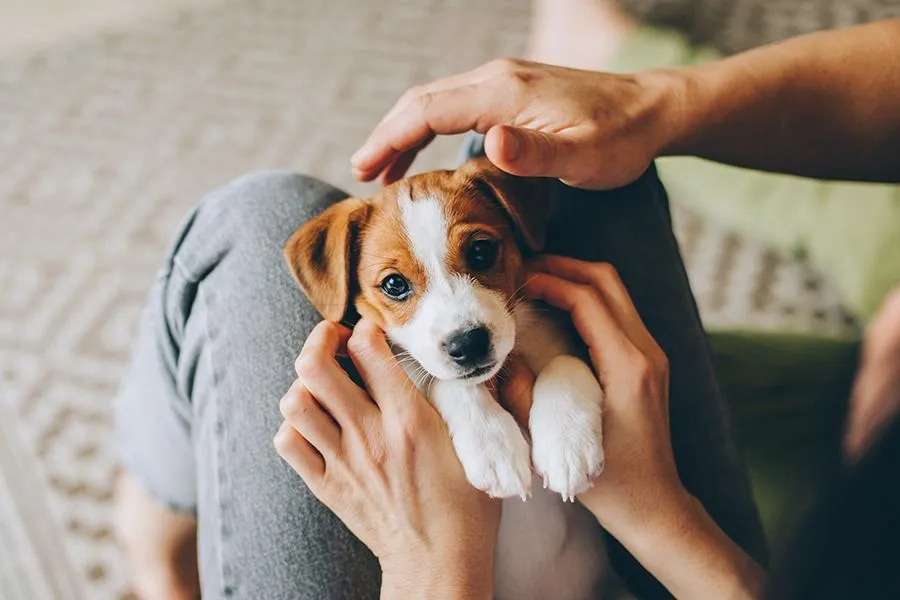
Bringing Your Puppy Home for the First Time
The Reality of Puppy Parenthood in 2025
Bringing home a puppy for the first time is equal parts thrilling and terrifying — and anyone who tells you otherwise probably forgot the first week entirely.
The excitement is real. So is the exhaustion, the doubt, and the 2 a.m. chorus of whimpering from a crate. This emotional roller coaster even has a name: Puppy Blues. Much like postpartum feelings in new parents, Puppy Blues is a recognized response to the sudden, seismic shift in routine, responsibility, and sleep. It's common, it's valid, and — critically — it passes.
What doesn't pass quite as quickly is the financial commitment. According to the Rover 2025 True Cost of Pet Parenthood Report, the average upfront cost of bringing home a new dog ranges from $1,150 to $4,420 in the first year alone. Inflation is compounding that pressure: pet parents should expect to spend approximately 11% more on veterinary fees and 20% more on grooming supplies this year compared to previous years.
Here's a simplified look at where those dollars typically go:
These numbers aren't meant to discourage — they're meant to prepare you. A realistic budget is an act of love for your dog.
This is the concept of Dog Pawtential — the idea that every interaction, environment, and experience during puppyhood is actively building the adult dog your pup will become. Early socialization, consistent routines, and informed choices aren't optional extras. They're the foundation.
Understanding what's ahead — emotionally and financially — is the first step toward getting it right. And getting it right starts with speaking the language: the terminology, timelines, and frameworks that experienced dog owners rely on from day one.
Essential Puppy Terminology for New Owners
Understanding the language of puppy development is the fastest shortcut to raising a confident, well-adjusted dog. Before diving into schedules and strategies, grounding yourself in a handful of core concepts will make everything that follows — from tips for house training a puppy to managing separation anxiety — click into place far more quickly.
These aren't just buzzwords. Each term below represents a behavioral principle backed by decades of research and practical application. Learn them now, and you'll spot opportunities (and avoid mistakes) that most first-time owners miss entirely.
**Socialization Window**
The concentrated developmental period, roughly **3 to 13 weeks of age**, during which a puppy forms lasting impressions about the world. As [Whole Dog Journal's Pat Miller notes](https://www.whole-dog-journal.com/), "the socialization window is even smaller than once thought — most agree it extends only from three weeks to about 13 weeks." Positive exposure to people, sounds, surfaces, and animals during this window builds lifelong confidence. Miss it, and you're working uphill indefinitely.
**Enforced Naps**
Scheduled, non-negotiable rest periods built into the daily routine — typically in a crate or exercise pen. Puppies need **16 to 18 hours of sleep per day**, and an overtired puppy behaves a lot like an overtired toddler: bitey, frantic, and inconsolable. Enforced naps prevent overstimulation before it starts.
**The 3-3-3 Rule**
A widely recognized adjustment timeline: **3 days** to decompress from the stress of transition, **3 weeks** to learn household routines and start feeling safe, and **3 months** to truly settle in and show their full personality. This framework helps new owners calibrate expectations and resist the urge to panic in the early days.
**Positive Reinforcement**
A training method centered on **rewarding desired behaviors** — with treats, praise, or play — rather than correcting mistakes. In practice, a puppy who gets rewarded for sitting before the food bowl hits the floor learns sitting is profitable. Punishment-based alternatives create confusion and erode trust, particularly in young dogs.
**Puppy-Proofing**
The proactive process of **auditing your home for hazards and temptations** — loose cords, toxic plants, accessible trash cans, and open staircases — before your puppy ever sets foot inside. A fail-proofed environment means fewer "no" moments and a safer learning space from day one.
With these concepts loaded, you're ready for the part that sets the tone for everything: the critical first 24 hours after your puppy arrives home.
The Critical First 24 Hours: Arrival and Exploration
The decisions you make in the first 24 hours set the behavioral foundation your puppy will build on for life — and the American Veterinary Society of Animal Behavior (AVSAB) notes that behavioral issues, not infectious diseases, are the leading cause of death in dogs under three years old. Getting these early moments right isn't optional; it's urgent.
Here's how to move through arrival day with intention:
Step 1 — The 'Potty First' rule. Before your puppy ever crosses the threshold of your home, take them directly to your designated bathroom spot outdoors. This single habit does more for your schedule for house training a puppy than almost anything else. Even if the puppy doesn't go immediately, you've already communicated where elimination belongs. Praise any success warmly and calmly, then head inside.
Step 2 — Introduce the home base area. Don't give your puppy a grand tour on day one. Lead them directly to the pre-prepared crate or pen area — what earlier sections defined as the "safe zone." Let the puppy sniff, investigate, and settle at their own pace. Place a worn article of your clothing inside to provide a familiar scent anchor. Forcing interaction at this stage backfires; passive curiosity is exactly what you want to see.
Step 3 — Limit the environment deliberately. Restrict access to one or two rooms using baby gates or closed doors. A puppy exploring an entire house is a puppy headed for accidents, anxiety, and exhaustion. A common pattern is to start with the kitchen or living room — spaces with easy-to-clean floors and natural family foot traffic. Expand their territory gradually over the coming days and weeks as confidence grows.
Step 4 — The first meal. Timing matters here. Wait at least 30 minutes after arrival before offering food, allowing the puppy's stress levels to settle. Use the same food the breeder or shelter provided — sudden diet changes compound digestive upset. Offer small portions and ensure fresh water is consistently available. Always follow the feeding guidelines for your puppy's breed and weight, and consult your vet if you're uncertain about quantities.
With arrival day managed thoughtfully, the next challenge most new owners face hits hardest after the lights go out — and that's where the real emotional test of puppy parenthood begins.
Where Should a Puppy Sleep on Its First Night?
Where your puppy sleeps on night one is one of the highest-stakes decisions you'll make — and the answer is simpler than the crying makes it feel.
Before midnight arrives and the whimpering begins, it helps to understand why it's happening. Your puppy has just lost everything familiar: the warmth of littermates, the scent of its mother, and the ambient sounds of its birth environment. This isn't behavioral defiance — it's a genuine grief response. According to the Utah Humane Society, puppies need 18 to 20 hours of sleep per day for healthy brain and physical development, which means a stressed, unsettled puppy isn't just sad — it's missing critical recovery time.
The single most effective first-night strategy is placing the crate in your bedroom, close to your bed. Your scent and the sound of your breathing provide an instinctive reassurance that no toy alone can replicate. This doesn't mean co-sleeping, and it doesn't mean a permanent arrangement — it simply gives your puppy a bridge between what it knew and what's new.
Crate Location: Bedroom vs. Elsewhere
The heartbeat toy strategy — placing a plush toy with a simulated heartbeat inside the crate — is widely recommended as a supplementary comfort tool. A warmed blanket from the breeder carrying familiar scents can also ease the transition significantly.
On the thorny question of whether to respond to whining: ignore sustained, low-level whining; respond promptly to urgent, escalating cries. The distinction matters. Rushing in at every whimper can inadvertently reward the behavior, while leaving a genuinely distressed puppy to cry it out creates unnecessary stress. A calm, brief reassurance — without removing the puppy from the crate — typically strikes the right balance.
Managing sleep well tonight sets up a critical chain reaction — because how rested your puppy is directly shapes how it behaves tomorrow. That connection between rest and behavior is worth understanding in depth, which is exactly what comes next.
The Science of Sleep: Preventing the 'Zoomies'
Sleep isn't downtime for a puppy — it's an active biological process that directly controls whether your dog can learn, stay calm, or function at all.
Once you've navigated the first night and established where your puppy sleeps, the next challenge is maintaining a rhythm that respects their sleep needs throughout the entire day. Most new owners misread overtired behavior as disobedience or bad temperament. In practice, it's almost always exhaustion wearing a disguise.
Spotting an overtired puppy is a skill worth developing immediately. The clearest signals include:
When puppies exceed their biological sleep limit, their bodies release cortisol and adrenaline, according to Elita Pet. This hormonal surge is what fuels those wild zoomie episodes and out-of-character biting. Critically, a puppy in this state cannot learn — the neurological conditions simply aren't right. Pushing through to "tire them out" actually makes the problem worse, not better.
The 1-hour up, 2-hours down rule is a reliable framework for managing this. For every hour of activity — playing, training, eating, exploring — a young puppy typically needs two hours of sleep. Most puppies between 8 and 16 weeks need 16–18 hours of total sleep per day. This rhythm also ties directly into feeding: just as you'll soon map out how many times a day a puppy should eat (usually 3–4 meals spaced through waking periods), nap windows should be built around those same active blocks.
Creating a sleep-conducive environment makes a measurable difference in nap quality. Consider:
One practical approach is to schedule naps proactively, before the zoomies start, rather than reacting after the meltdown is already underway.
With sleep cycles mapped out, the next piece of the daily structure puzzle is equally time-sensitive: building a reliable house training schedule that works in sync with your puppy's waking windows.
House Training 101: Schedules and Treats
Consistent schedules and immediate positive reinforcement are the two non-negotiable pillars of potty training — without both working together, progress stalls fast.
Just as the previous section established that sleep deprivation scrambles a puppy's ability to learn, an inconsistent potty routine makes behavioral chaos almost inevitable. Research from Dog Owners Academy shows that proper exposure and training during the first 14 weeks can reduce the risk of future behavioral problems by more than 60% — and house training is ground zero for that window.
The "Every 30 Minutes" Rule is the baseline for puppies under 12 weeks. Young puppies have tiny bladders and almost no sphincter control, which means they physically cannot hold it for long. Take your puppy outside every 30 minutes during waking hours, and always immediately after naps, meals, play sessions, and excitement — which covers most of the day. As Great Pet Care notes, consistency in timing is what builds the habit, not the puppy's willpower.
Here are the core Potty Training Commandments every new owner needs to follow:
One practical note: schedule your first potty-training week around your puppy's upcoming appointments, including taking your puppy to the vet for the first time. A well-timed vet visit will also give you a professional baseline on your puppy's diet — which directly influences how often and predictably they need to go out. Speaking of which, what goes in determines what comes out, which is exactly why nailing down the right feeding schedule matters just as much as the potty routine itself.
Feeding and Nutrition: How Many Times a Day?
What you feed your puppy — and when — directly shapes their energy, development, and house training progress from the first night with a new puppy onward.
Getting nutrition right isn't complicated, but it does require consistency. Puppies have small stomachs and high metabolic demands, which means their feeding schedule looks very different from an adult dog's routine.
How often? Puppies under 6 months need 3 to 4 meals per day, spaced evenly throughout the day. A common practical approach is meals at 7 a.m., 12 p.m., and 5 p.m., with a fourth feeding added for very young or small-breed pups. After 6 months, most puppies transition comfortably to twice-daily feedings. The ASPCA Pet Health Insurance recommends keeping meal timing predictable — erratic feeding windows make everything harder, including sleep and potty training.
How does feeding connect to potty training? Directly and immediately. As covered in the house training section, puppies typically need to eliminate within 10 to 30 minutes of eating. Scheduled meals create scheduled bathroom opportunities, which is exactly why free-feeding — leaving food out all day — undermines housebreaking. When food goes in on a schedule, you can predict when it needs to come out.
What kind of food? Always choose food labeled specifically for puppies or "all life stages." Adult formulas don't contain the right ratios of calcium, phosphorus, and protein that a growing dog needs. When reading labels, look for:
Note that upfront puppy supply costs have risen in 2025, and premium kibble is no exception — budget accordingly rather than defaulting to the cheapest option.
What's dangerous? Several common human foods are toxic to puppies. Avoid giving your dog any of the following:
A puppy's diet is the foundation of everything else — behavior, energy, and health. Nail the feeding schedule now, and you'll be in a much stronger position when your first vet appointment arrives to confirm you're on the right track.
The First Vet Visit: What to Expect
Your puppy's first vet appointment isn't just a formality — it's a critical health baseline that can catch hidden issues and set the vaccination schedule that protects your dog's entire future.
Schedule this visit within 48–72 hours of bringing your puppy home. Most breeders and rescues require it, and for good reason: conditions like intestinal parasites, heart murmurs, or respiratory infections can be easy to miss without a trained eye. The sooner a vet clears your puppy — or flags a concern — the sooner you can act.
Vet Visit Go-Bag Checklist
Pack these items before you leave the house:
Understanding the vaccination schedule is one of the most valuable conversations you'll have with your vet. Core vaccines follow a tiered timeline, typically beginning at 6–8 weeks and continuing through 16 weeks:
One important caveat: your puppy is not fully protected until 1–2 weeks after the final booster. This timing directly affects the puppy socialization window — a concept your vet can help you navigate without sacrificing critical early exposure.
Spay and neuter timing is another conversation worth initiating at this first visit. Guidelines have shifted in recent years, with many veterinarians now recommending waiting until 12–18 months for larger breeds to allow hormonal development to complete. There's no universal answer, so discussing your puppy's breed, size, and lifestyle with your vet leads to the most informed decision.
That socialization window your vet mentions? It closes faster than most new owners realize — and what happens inside it shapes your dog's behavior for the next decade.
Socialization: Immunizing Against Fear
The socialization window is the single most time-sensitive opportunity in your puppy's entire life — and most new owners don't realize it's already closing.
As the Whole Dog Journal puts it, socialization is "immunization against fear." That framing captures the urgency perfectly. Between roughly 3 and 16 weeks of age, a puppy's brain is actively wired to accept new experiences as normal. Miss that window, and you're not just dealing with a shy dog — you're potentially facing 10 to 15 years of reactivity, anxiety, and behavioral challenges that no amount of training fully erases.
Safe socialization before full vaccination is possible and encouraged. The ASPCA notes that the risk of behavioral problems from under-socialization far outweighs the disease risk of carefully managed early exposure. In practice, this means avoiding dog parks and unknown dogs on the ground — but it doesn't mean staying home.
The "Rule of 7" is a practical framework: before 7 weeks old, a puppy should have experienced 7 different surfaces, 7 different locations, 7 types of people, and so on. You can continue expanding this list through your socialization window with:
One critical distinction: socialization is not the same as "meeting other dogs." Many owners assume regular dog-to-dog play covers the full picture. It doesn't. A puppy needs exposure to the entire sensory landscape of human life — not just other animals. Overloading on dog interaction while skipping novel environments and people creates a dog that's dog-social but human-anxious or environment-reactive.
Keep every exposure brief, positive, and below your puppy's stress threshold. If they freeze, cower, or refuse treats, you've pushed too far — dial back immediately.
Getting socialization right sets a foundation of confidence that makes everything else easier — including teaching your puppy to feel safe when you leave the room, which is a challenge worth addressing head-on next.
Preventing Separation Anxiety from Day One
Building independence from the very first night is one of the highest-impact investments you can make in your puppy's long-term behavioral health. The RSPCA identifies preventing separation-related behavior as a core component of early puppy welfare — which means this isn't something to address later. It starts today.
The Den Concept
The crate is not a punishment. Framed correctly, it becomes your puppy's personal den — a calm, predictable space that belongs entirely to them. In practice, this means:
A common pattern is puppies who resist crates simply because they were introduced too fast. Go slow. Let your puppy investigate on their own terms before ever closing the door.
The Short Departure
Once the crate feels safe, begin practicing micro-absences — brief periods of alone time while you're still in the house. Step into another room for 30 seconds, then return calmly. Gradually increase this to 2 minutes, then 5, then 15.
The critical detail here is the 'Safe Departure' ritual: no dramatic goodbyes and no enthusiastic hellos. Big emotional exits teach the puppy that your leaving is an event worth panicking over. What typically happens when owners skip this step is a dog that escalates into frantic behavior the moment a jacket comes off the hook.
The Reward
A stuffed KONG or long-lasting chew is your most practical tool here. Freeze a KONG filled with peanut butter or wet food and offer it exclusively when your puppy is settling alone. This creates a positive association: alone time predicts something wonderful.
One practical approach is preparing five or six frozen KONGs on Sunday so you have them ready throughout the week.
Done consistently, these three steps — den, short departures, and high-value rewards — build a puppy that tolerates solitude without distress. The next section pulls every strategy in this guide into a single actionable checklist you can start using tonight.
Key Takeaways: Your Puppy Survival Checklist
The first week with a new puppy isn't about perfection — it's about building the foundation of trust, routine, and safety that shapes the next decade of your dog's life.
Everything covered in this guide distills down to five core principles. Return to this checklist whenever the overwhelm sets in.
One practical approach is to print this checklist and keep it somewhere visible during the first two weeks. The principles don't change when you're sleep-deprived and cleaning up a fourth accident before breakfast.
The good news? The structure you're building right now compounds. Stay consistent through the hard early days, and you'll find everything starts to click — which is exactly what the final section covers.
Unlocking Your Dog's Full Pawtential
The structure you build in week one becomes the invisible framework that holds your dog's happiness together for the next ten to fifteen years. That's the golden thread running through every section of this guide — from crate training logistics and sleep schedules to bite inhibition and separation anxiety prevention. Routine isn't a constraint on your puppy's joy. It's the very foundation of it.
In practice, the first week feels relentless. The midnight wake-ups, the puddles, the frantic leash-chewing — it's a lot. But what typically happens by week three or four is a quiet, almost surprising shift. The puppy who trembled in the corner on night one is now trotting confidently to their crate, reading your cues, and sleeping through until 6 a.m. That transformation isn't accidental. It's the direct return on the investment you made when everything felt hardest.
Behavioral health is the number one factor in long-term dog-owner retention — and the decisions you make in these early weeks are the single greatest lever you have over that outcome. According to Dog Owners Academy, owners who establish clear routines and positive associations from day one are dramatically more likely to describe their dog as a seamless part of the family years later. The hard work compounds.
This guide is your foundation, but the journey doesn't stop here. Each topic — loose-leash walking, advanced crate independence, socialization windows, recall training — deserves its own deep dive. Explore the spoke articles in this series to continue building on what you've started. Every technique is designed to layer cleanly onto the structure you've already put in place, so nothing you've done this week goes to waste.
Your puppy isn't just an animal you're managing through an awkward developmental phase. They're a decade-plus companion in the making, and every patient, consistent choice you make right now is quietly shaping who they'll become.
Don't navigate the first month alone.
Sign up for the Dog Pawtential "First Month" Newsletter Get week-by-week training milestones, troubleshooting guides, and expert tips delivered directly to your inbox — so you're always one step ahead of whatever your puppy throws at you next.
🐾 Related Reads

The Definitive Beginners Guide To Raising A Dog
Master dog training 101 with our science-based guide. Learn positive reinforcement, crate training, and how to stop puppy biting for a happy, well-behaved dog.

Getting A Puppy
Bringing your puppy home for the first time is exciting—and a little overwhelming. Start by creating a safe, quiet space with a bed, water, and a few toys....

How To Socialize A Puppy
Step 1: Identify the Critical Socialization Window Missing this window doesn't just slow progress — it can cost a dog its life. According to the American...

How To Stop Your Dog From Pulling On The Leash
How to Prepare Your Gear and Environment Learning how to train a dog not to pull on leash starts before you ever step outside. The right equipment and a...