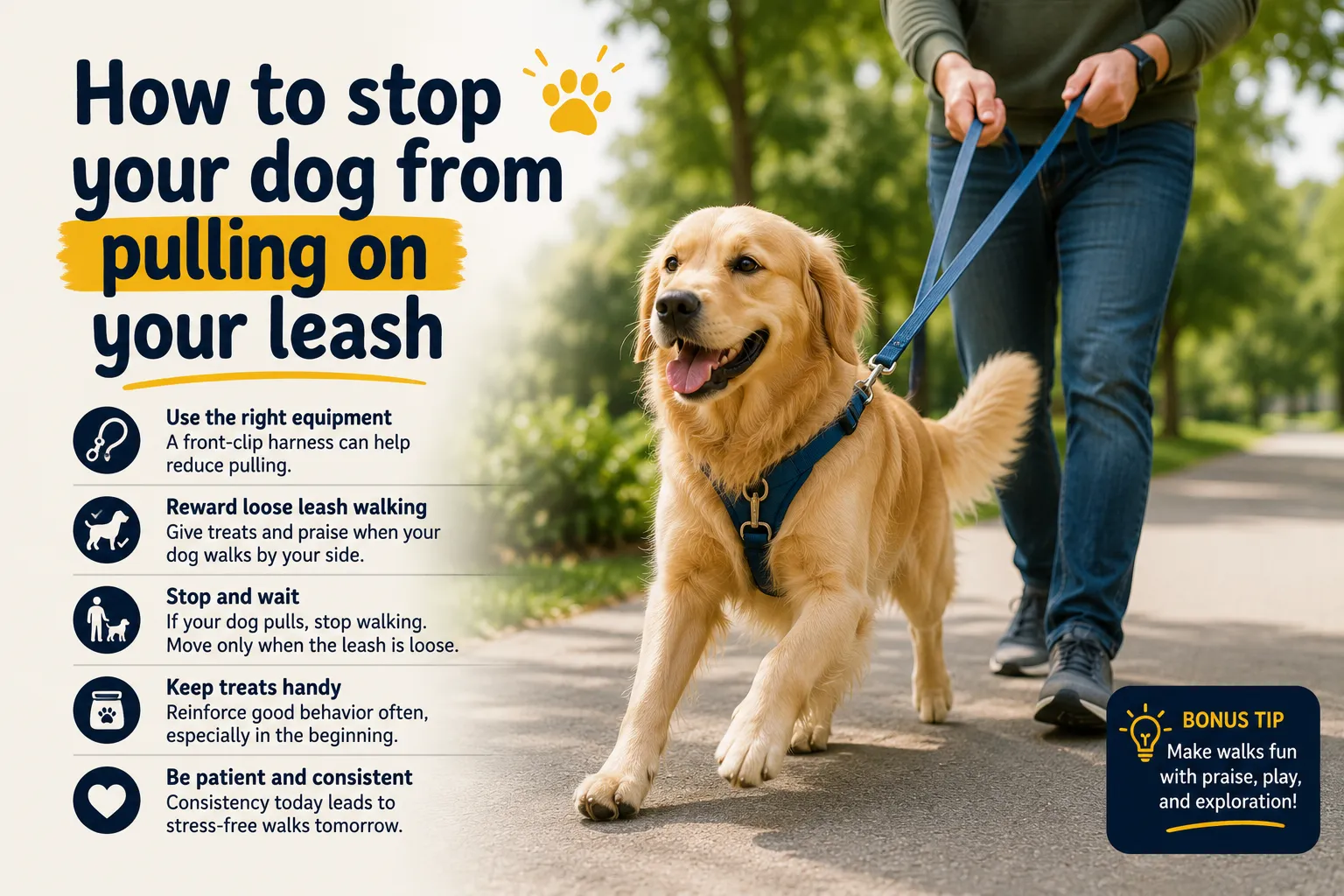
How To Stop Your Dog From Pulling On The Leash
How to Prepare Your Gear and Environment
Learning how to train a dog not to pull on leash starts before you ever step outside. The right equipment and a low-distraction setting do half the work for you — set these up correctly, and every technique that follows becomes significantly easier to apply.
Equipment matters more than most owners realize. According to the American Kennel Club, front-clip harnesses reduce pulling by redirecting a dog's forward momentum to the side rather than letting them barrel straight ahead. That single swap can produce noticeable improvement on day one.
Here's your essential gear checklist before your first training session:
- Front-clip harness — redirects forward lunges sideways, discouraging pulling naturally
- Standard 6-foot leash — gives you consistent, predictable control over your dog's position
- High-value treats — think small pieces of chicken or cheese, reserved exclusively for leash training sessions
- A quiet starting environment — a backyard or indoor hallway before graduating to busier streets
Retractable leashes actively undermine training. They teach dogs that pulling pays off by rewarding forward pressure with more freedom — the exact opposite of what you need.
Once your gear is dialed in, you're ready for the single most effective technique for stopping a pulling dog the moment it happens.
Step 1: Master the 'Be a Tree' Technique
The core of learning how to teach a dog not to pull on leash comes down to one counterintuitive move: doing absolutely nothing. The moment your leash goes taut, stop walking. Plant your feet. Don't yank back, don't scold — just become a tree.
As Alexandra Bassett notes via Rover.com, dogs have a natural instinct to resist pressure, meaning tension on the leash actually triggers them to pull harder. Fighting force with force only escalates the problem. Stillness is the circuit-breaker.
Here's the full sequence:
- Feel the leash tighten — stop forward movement immediately, mid-stride if needed.
- Hold your position — keep both feet planted and the leash held steady at a neutral height. Do not jerk or tug backward.
- Wait for slack — stay still until your dog looks back at you or steps toward you, releasing tension in the leash.
- Resume walking — the instant slack returns, move forward as your dog's reward for the correct behavior.
The opposition reflex explained: According to the Animal Humane Society, pulling back on a taut leash triggers an automatic forward-pushing response in dogs — the same instinct sled dogs use. Stillness bypasses this reflex entirely.
Consistency is everything here. Every single taut leash moment must result in a full stop — no exceptions. Once your dog reliably offers that backward glance to earn forward motion, you're ready to build on it by rewarding those check-ins strategically.
Step 2: Reward the 'Check-In' with High-Value Treats
Check-ins — those brief moments your dog glances back at you mid-walk — are the secret weapon for figuring out how to get a dog to stop pulling on leash. The challenge is capturing that split second before the dog's attention drifts elsewhere.
Marker timing is everything. The instant your dog's eyes meet yours, say "Yes!" or click a clicker. That precise mark tells the dog exactly which behavior earned a reward. Then deliver the treat directly at your hip, not in front of you. Feeding at hip level plants the idea that staying beside you — in heel position — is the most profitable place to be, as Best Friends Animal Society reinforces in their loose-leash guidance.
Distraction level determines reward frequency. In a quiet backyard, rewarding every third check-in may be enough. Near a busy park — where leash pulling is the behavior 24% of dog owners most want to change — bump the rate up significantly to compete with the environment.
Use the 7-7-7 rule to build consistency: practice for 7 minutes, in 7 different spots, over 7 consecutive days. Short, repeatable sessions prevent burnout and reinforce the habit across varied contexts.
Pro Tip — Treat Timing: Aim to deliver the treat within 1.3 seconds of the marker. Any longer and the dog may have shifted position, accidentally rewarding the wrong behavior. Pre-load treats in your left hand so nothing slows you down.
Once check-ins become reliable, you'll need a strategy for the moments your dog still surges ahead — which is exactly where the next technique comes in.
Step 3: Implement the 'About-Face' Turn
Building on the check-in rewards from Step 2, the about-face turn takes that momentum further by making you the most interesting thing on the walk. According to the National Institutes of Health, approximately 82.7% of pet dogs pull while on a lead — so your dog is far from alone. The good news? A simple directional change disrupts the pulling pattern fast.
How to execute the about-face turn:
- Spot the pull early. The moment your dog surges ahead and the leash tightens, resist the urge to drag them back. Instead, pause briefly.
- Turn 180 degrees calmly. Pivot away from your dog and walk in the opposite direction. Call their name in a happy, upbeat tone as you change course — no frustration in your voice.
- Reward the catch-up. When your dog trots alongside you, mark and reward immediately with a treat or praise.
In practice, repeating this sequence consistently communicates one clear message: pulling never leads anywhere. Over time, your dog learns that staying beside you keeps the walk moving forward — a foundational concept in heel training for dogs. Once this pattern clicks, you're ready to layer in more structured practice, which the next step covers in detail.
Step 4: Practice Heel Training in 5-Minute Bursts
If you've ever wondered how to stop leash pulling, the honest answer is that consistency across many short sessions beats one long, exhausting workout every time. According to the AKC, consistency is the primary driver of success in canine behavioral modification — and brief, focused repetitions are how that consistency stacks up.
Keep sessions sharp with these four principles:
- Cap sessions at 5 minutes. A dog's attention fades quickly. Short bursts maintain focus and prevent frustration on both ends of the leash.
- End every session on a win. Finish with a "jackpot" reward — a small handful of high-value treats — after a successful heel. This leaves your dog eager for the next session.
- Layer in basic commands. Weave "sit" and "look" cues into the walk naturally. Pausing at a curb and asking for a sit, for example, reinforces impulse control without breaking momentum.
- Gradually extend duration. Once your dog holds a loose leash reliably, stretch sessions to 7 then 10 minutes — but only when the shorter version feels solid.
Progress compounds quickly when every session ends positively and builds on the last. Of course, even well-structured sessions hit turbulence when real-world distractions enter the picture — which is exactly what the next step addresses.
How to Handle Distractions and Setbacks
Even after mastering short-burst heel training, real-world distractions — squirrels, cyclists, other dogs — can send progress sideways fast. The key is having a clear plan for each trigger before it happens.
| Distraction | Solution |
|---|---|
| Another dog on the path | Cross the street; increase distance before your dog reacts |
| Squirrel or wildlife | Cue an about-face turn immediately; reward focus on you |
| Loud noises or traffic | Move to a quieter route; lower expectations for that session |
| Off-leash dogs approaching | Step behind a parked car or barrier; create a visual block |
Create distance first. The moment your dog locks onto a trigger, its learning brain shuts down. Adding space before the leash goes tight is always the priority.
Use decompression walks on a long line in low-traffic parks or fields. Allowing your dog to sniff and explore freely reduces overall stress levels, which makes focused training sessions more productive afterward.
Accept non-linear progress. Some days — new environments, heat, illness — will simply be harder. That's normal, not failure.
Never use physical punishment. According to Loving Pets, aversive corrections increase anxiety, which almost always amplifies pulling rather than reducing it.
Handling setbacks well is ultimately about consistency — which leads directly into the key habits that lock in long-term results.
How to Maintain Progress: Key Takeaways
Leash pulling is one of the most common reasons owners struggle to enjoy daily walks — and according to the PDSA Animal Wellbeing Report, owners consistently cite it as a top concern affecting their everyday wellbeing. The good news: the solution isn't complicated. It just requires repeating the right habits until they stick.
Use this ordered summary to keep your training on track:
- Consistency: Never allow forward movement while the leash is tight. Every single walk reinforces either the right habit or the wrong one.
- Engagement: Reward your dog for choosing to look at you — [voluntary attention](https://www.youtube.com/watch?v=mM-YIoJyko8&vl=en-US) is the foundation of a loose leash walk.
- Equipment: A front-clip harness reduces pulling force and redirects momentum without relying on discomfort.
- Patience: Building a reliable loose leash walk takes weeks of short, consistent sessions — not a single afternoon.
Progress compounds over time. Dogs that once dragged their owners down the sidewalk regularly become calm, attentive walking partners — with the right framework applied daily. Start your next walk with these four principles in mind, and the improvement will follow.
🐾 Related Reads
How To Socialize A Puppy
Step 1: Identify the Critical Socialization Window Missing this window doesn't just slow progress — it can cost a dog its life. According to the American...
The Definitive Beginners Guide To Raising A Dog
Master dog training 101 with our science-based guide. Learn positive reinforcement, crate training, and how to stop puppy biting for a happy, well-behaved dog.

How To Tire Out A High Energy Dog
How to Understand Your Dog's Energy Needs Learning how to tire out a high energy dog doesn't have to be complicated. Knowing how to tire out a...
How To Crate Train Your Dog
The Problem: Why Generic Crate Training Fails First-Time Owners Crate training a puppy is one of the most misunderstood processes in pet ownership — and that...